Random TD
- 4.1
- Rating
- 1.00M
- Installs
- Free
- Price

 Analysis by App-foxy
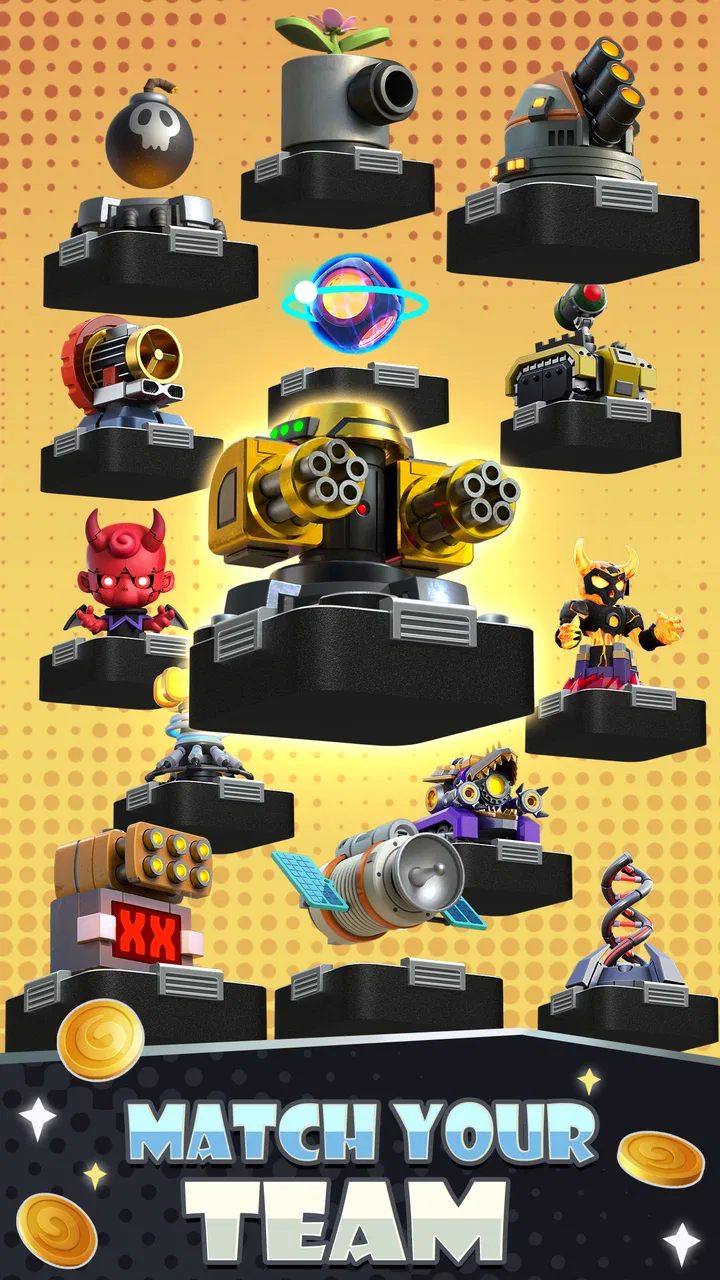
Random TD is the kind of casual tower-defense game I can open when I have a few spare minutes and still feel that I am working toward something. Developed by Mountain Lion, it focuses on a simple promise: build a defense from a changing selection of towers, learn what each one does, and keep unlocking more possibilities. That random element gives the familiar tower-defense formula a less predictable rhythm than a fixed campaign.
I found the appeal strongest when I wanted a game that was easy to understand but not completely automatic. The basic idea is approachable for an Everyone-rated audience, yet the changing tower choices encourage small decisions instead of letting me repeat one perfect setup every time. It is free to download, which makes trying it painless, although optional in-app purchases range from under a dollar to almost a hundred dollars per item. That price range is worth keeping in mind before settling into a long-term routine.
How the early goals create momentum
The first useful goal is not simply surviving a single round. It is learning the personality of the available towers and understanding which abilities deserve attention when the selection is not exactly what I wanted. Because the game revolves around dozens of towers waiting to be unlocked, progress has a clear collecting angle. Each new tower can change how I think about the next attempt, even before I know whether it will become a regular part of my strategy.
You May Also Like

 Google Keep - Notes and lists
Google Keep’s Quiet Growth Shows the Appeal of Simpler Notes
As mobile work gets busier, Google Keep keeps winning a simple contest: capture a thought quickly, find it later, and get on with the day.

 Blood Strike: 2.5 Anniversary
Blood Strike’s Loadouts Turn Every Drop Into a Tactical Gamble
A close look at Blood Strike’s custom loadouts: how fast access to signature weapons reshapes its battle royale rhythm, rewards preparation, and narrows the gap between fights.

 Pandora - Music & Podcasts
Pandora’s Music Is Easy to Start, but Harder to Recover
Pandora’s strength is its low-effort path from a seed to a station. Its weak spot is how much confidence it asks you to place in connection, setup, and quiet recovery.

 8 Ball Pool
 Is Built on Rivalries, Rematches, and Routine
A close look at the rivalries, rematches, shared routines, and unanswered safety questions that turn a quick pool match into a persistent mobile community.

 Samsung Music
’s Quiet Strength Is Playing What You Already Own
Its reach comes less from spectacle than from dependable access to a personal library. That simplicity is both the app’s strongest retention engine and its ceiling.

 AccuWeather: Weather Radar
AccuWeather Review: A Quick, Clear Forecast for Everyday Decisions
For everyday plans, the best forecast is the one you can understand quickly. AccuWeather makes rain timing, radar, and local conditions easy to act on, with a few trade-offs.
More From Our News Desk



That makes the opening experience more interesting than a tower-defense game built around one permanent roster. In a conventional title, I usually learn a map, memorize enemy paths, and repeat a proven build. Here, the early question is more flexible: what can I do with the tools I have now? I enjoyed that limitation because it made ordinary victories feel like small experiments rather than rehearsals.
For a new player, I recommend resisting the urge to spend every resource or commit to the first tower that appears useful. The better early habit is to watch how each ability affects the whole defense. A tower that looks modest on its own may be valuable when it fills a gap left by another option. Conversely, a powerful-looking choice may not help if the rest of the available lineup cannot support it.
This is also where the casual design works well. I did not need a long explanation before understanding the central loop. The game gives me an immediate reason to continue: discover another tower, test another combination, and see whether a different arrangement lasts longer. That is a more practical early objective than chasing an abstract score, particularly for players who are new to the genre.
Unlocks are most useful when treated as experiments
The unlock structure gives progress a visible shape, but I would not approach it like a checklist that must be completed as quickly as possible. The real value of a new tower is the decision-making it creates. When I unlock something unfamiliar, I want to ask what problem it solves, what it fails to solve, and whether it changes how I spend the rest of my defensive options.
That approach also prevents the collection system from becoming purely cosmetic. A growing roster matters because it widens the number of situations I can handle. It does not automatically make every run easier. In fact, more choices can make the game less comfortable at first because I have to evaluate them instead of relying on a single familiar answer.
A useful everyday scenario is a short evening session after work or school. I can play one attempt with a simple goal, such as trying a newly unlocked tower rather than maximizing the result. If the run goes badly, it still teaches me something about that tower’s role. If it goes well, I have a reason to return and see whether the same idea works when the available selection changes.
Progress feels clearer through changing possibilities
Random TD communicates progress less through a traditional story and more through the expanding set of defensive possibilities. The most satisfying signal is recognizing that I now understand a tower that once seemed awkward. A new unlock is an obvious milestone, but improved judgment is just as important: I begin to notice which abilities complement one another and which combinations leave a dangerous weakness.
That kind of progress is easy to miss if I only measure success by whether a run ends in victory. The game rewards familiarity with its roster, not just persistence. After several sessions, I found myself making quicker decisions because I had built a mental map of the towers. I knew which ones deserved immediate attention, which ones needed support, and which ones were better saved for a particular defensive shape.
The random format gives those signals more weight. If the same towers appeared in the same order every time, learning would eventually become memorization. Here, knowledge has to remain flexible. I may understand the general strength of a tower while still needing to adapt when another important ability is missing. That is a good fit for players who enjoy improving their decisions more than simply unlocking a linear chain of upgrades.
There is a trade-off, though. Players who prefer highly transparent progression may find this less satisfying than a conventional campaign with clearly labeled stages and guaranteed rewards. The collection idea provides direction, but it does not replace the feeling of working through a carefully authored sequence. If I want a tower-defense game that teaches one mechanic at a time and steadily introduces a planned cast of towers, a more traditional alternative may be a better match.
What to watch before committing to a run
My strongest practical tip is to evaluate the whole defensive situation before judging an individual tower. Random selection can tempt me to focus on the most impressive ability in front of me. That is often the wrong question. I get better results by considering whether my current options cover the basic needs of the defense and then using the new tower to strengthen the weakest area.
I also found it helpful to treat each attempt as a test with one clear purpose. Trying to learn every tower, chase the best result, and unlock progress at the same time can make a short session feel unfocused. Choosing one objective keeps the random element manageable. For example, I might concentrate on understanding a tower’s timing or on seeing how long a particular combination remains effective.
Another non-obvious advantage is that failure can be informative without requiring a long commitment. When a setup breaks down, I can identify whether the problem came from the selected abilities, the order in which I used them, or a lack of balance in the defense. That makes the game more approachable than a system where one mistake ruins a lengthy campaign, even though the randomness may still produce frustrating outcomes.
Challenge and pacing: enough pressure for short sessions
The challenge works best when I stop expecting every attempt to feel equally comfortable. A random tower-defense setup naturally creates uneven runs. Sometimes the available tools seem to fit together immediately; at other times, I have to make do with a less obvious plan. That variation keeps the opening moments from becoming routine, but it also means the difficulty can feel less predictable than in a fixed-level game.
I see that as the central pacing trade-off. The game sustains interest by changing the problem, not necessarily by presenting a carefully measured sequence of handcrafted challenges. For me, that is effective during short sessions because I can start again with a different question in mind. For players who dislike losing because the available choices feel unfavorable, the same design may feel like pressure rather than variety.
The difficulty curve is therefore tied to understanding rather than just stronger equipment. Unlocking more towers gives me more ways to respond, but it also asks me to make better choices. I cannot assume that a larger collection will remove the challenge. The game remains engaging when I use new options to think more carefully, not when I treat them as automatic upgrades.
That distinction matters when comparing Random TD with the usual casual tower-defense alternatives. Many of those games emphasize predictable lanes, fixed tower trees, or a steady campaign where the main skill is remembering the intended solution. Random TD is better for someone who wants replayable decisions and a little uncertainty. It is less suitable for someone who wants to perfect one map through exact placement and repeatable timing.
Where the pacing can become tiring
The same randomness that refreshes the game can eventually create friction. If I am trying to reach a particular unlock or improve a personal result, an unfavorable selection can make progress feel slower than expected. I may understand what went wrong and still have limited control over whether the next attempt gives me the tools I want. That is not necessarily a flaw in the concept, but it is a real limitation for players who prefer direct control over advancement.
The free-to-play structure adds another point of caution. Since optional purchases extend from $0.99 to $99.99 per item, I would decide on a spending limit before playing regularly. The free entry is helpful for testing whether the random format suits me, but the existence of high-priced purchase options means I would not treat the game as automatically cost-free over time. Anyone sensitive to collection pressure should pay attention to how often they feel encouraged to speed up progress or chase another unlock.
I also would not recommend it as the first choice for someone seeking a deep, story-led strategy experience. Its strength is the compact loop of choosing, adapting, and unlocking. That can be satisfying, but it is a narrower kind of engagement than a large campaign with extensive world-building, detailed maps, and a long-term strategic economy. Random TD knows what it wants to be, and the player needs to want that same kind of focused replay.
Does the unlock loop sustain long-term play?
For me, the retention comes from the combination of curiosity and adaptation. I want to see what the next tower adds, but I also want to become better at using the towers I already know. Those are two different motivations, and they support each other. If a new unlock feels unfamiliar, I have a reason to play again; if a familiar tower works better after practice, I have a reason to revisit an earlier idea.
The loop is strongest for players who enjoy setting personal challenges. I can aim to make a less obvious tower work, build around a limited selection, or improve my response to a difficult situation. These goals are more satisfying than simply repeating the same winning formula. They also make the game useful as a low-pressure way to practice quick planning.
On the other hand, the retention may be weaker for anyone who needs a strong external reward structure. Unlocking dozens of towers sounds substantial, but the enjoyment depends on caring about how those towers change play. If I do not enjoy experimenting with different abilities, the collection goal alone may not carry the experience for long. The game is not a replacement for a carefully paced competitive title or a full strategy campaign.
The audience size suggests that the concept has found a substantial casual following: the game has more than a million installs, with an average rating of 4.1 from roughly twenty-eight thousand ratings and about one thousand reviews. I read those figures as evidence that the basic formula is accessible, not as a guarantee that every player will enjoy the random structure. The important question is whether I like making decisions with incomplete control.
Who should play, and who should skip it?
I would recommend Random TD to someone who wants a free casual game for short, repeatable sessions and enjoys collecting new defensive options. It is particularly suitable for players who like discovering interactions rather than following a single optimal guide. The Everyone content rating also makes it an easy game to consider for a broad audience, provided the optional purchase model is handled thoughtfully.
I would suggest skipping it if my priority were a completely predictable difficulty curve, a fixed campaign, or a tower roster that I can control from the beginning. I would also be cautious if random outcomes quickly make me feel that my decisions do not matter. The game asks me to work within the choices presented, so its appeal depends on seeing constraints as puzzles rather than unfair interruptions.
Device compatibility is reasonably broad for older Android hardware because it supports Android 6.0 and later. That makes it more accessible than games that require a recent operating system, although compatibility alone does not determine how comfortable a particular device will feel during play. I would still judge the experience by how smoothly the game responds on my own phone or tablet rather than assuming every supported device behaves identically.
My progression verdict after weighing the trade-offs
Random TD succeeds when its goals remain small and concrete: learn a tower, test a combination, survive a difficult setup, and work toward another unlock. The progression does not need a complicated presentation because the changing roster supplies the main source of discovery. I enjoyed the way it turned familiar tower-defense decisions into flexible problems instead of fixed instructions.
Its challenge is also its identity. Random choices keep the pacing from becoming completely routine, but they can make progress feel less direct. The game rewards patience, observation, and a willingness to make the best of an imperfect selection. It is not the right fit for players who want every loss to be traceable to a precise mistake or every unlock to arrive on a predictable schedule.
Mountain Lion’s game is at its best as a compact, replayable casual experience rather than an all-purpose strategy title. I would install it for a quick session, especially when I want a little planning without committing to a long campaign. I would keep my spending boundaries clear, treat each run as an experiment, and judge progress by better decisions as much as by new towers.
My final recommendation is positive, with that qualification in mind. Random TD is worth trying if the idea of adapting to changing tower choices sounds more appealing than repeating a perfect build. The free starting point makes that test easy, and the growing collection gives the game a reason to stay installed. Just do not expect a fully controlled progression path; its lasting appeal comes from learning how to turn uncertainty into a workable defense.
FAQs for Random TD
01What is Random TD and how does its gameplay work?
Random TD is a tower defense game built around chance-based unit summoning and strategic placement. You defend your base against waves of enemies while combining, upgrading, and positioning randomly obtained towers. Each match requires more than simply placing the strongest units, because tower abilities, attack ranges, upgrade timing, and synergy can determine whether you survive difficult waves.
02Is Random TD free to download and play?
Random TD can generally be downloaded and played for free, although the game may include optional in-app purchases. These purchases can provide currencies, packs, upgrades, or other progression-related items, but spending is not necessarily required to understand the core gameplay. Players should still expect advertisements, limited resources, and some progression systems designed to encourage regular play or optional purchases.
03Does Random TD require an internet connection?
An internet connection may be needed for important parts of Random TD, especially multiplayer matches, account synchronization, advertisements, events, rankings, and in-app purchases. Some features may work temporarily while offline, but the exact experience can depend on the version installed and the platform being used. For the most reliable performance, play with a stable Wi-Fi or mobile data connection.
04Is Random TD suitable for beginners?
Random TD is accessible to newcomers because its basic objective is easy to understand: build a defense and stop incoming enemies. However, the random tower system introduces a learning curve. New players must experiment with combinations, recognize useful unit synergies, and learn when to merge or upgrade. Early matches are a good way to practice before competing in more demanding modes.
05Does Random TD include multiplayer or competitive features?
Random TD is designed to offer more than a traditional solo tower defense experience, with competitive or cooperative elements depending on the available game modes and current version. Multiplayer matches can be more unpredictable because opponents, teammates, and random tower selections influence the outcome. Players who prefer relaxed sessions should be prepared for a faster, more competitive experience in these modes.
Pros
- Simple tower-defense mechanics are easy for newcomers to understand.
- Randomized towers and enemies make each match feel different.
- Short rounds suit quick gaming sessions on mobile devices.
- Upgrade choices add variety and encourage different defensive strategies.
- Bright visuals and clear effects make battles easy to follow.
Cons
- Random outcomes can make some matches feel heavily dependent on luck.
- Difficulty may rise sharply after the early stages.
- Limited strategic control may disappoint experienced TD players.
- Repeated runs can become predictable once familiar patterns emerge.
- Frequent effects and animations may drain battery on older devices.

Random TD
Gallery